The Light Adjustable Lens provides optimized vision for patient satisfaction.2
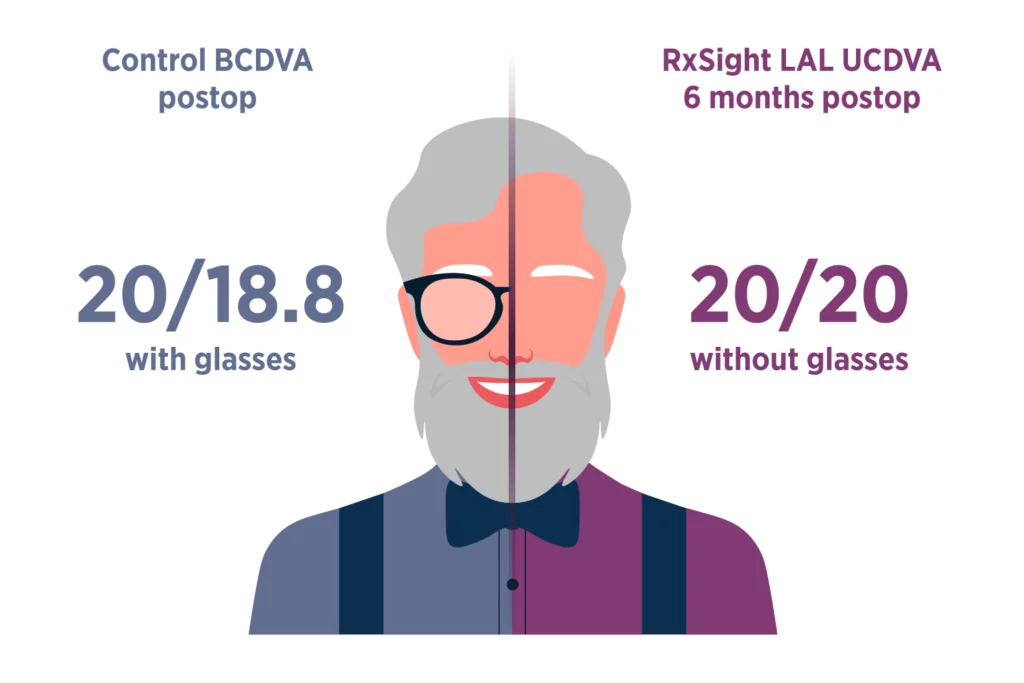
Light Adjustable Lens patients saw nearly as well without glasses (UCDVA) as control patients did with glasses (BCDVA).
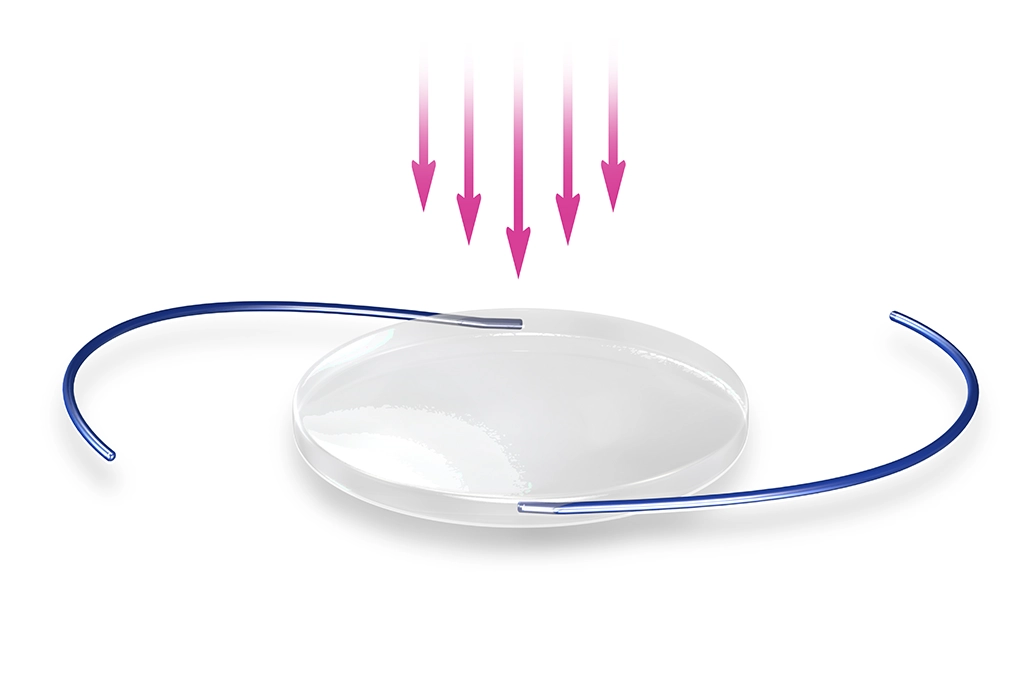
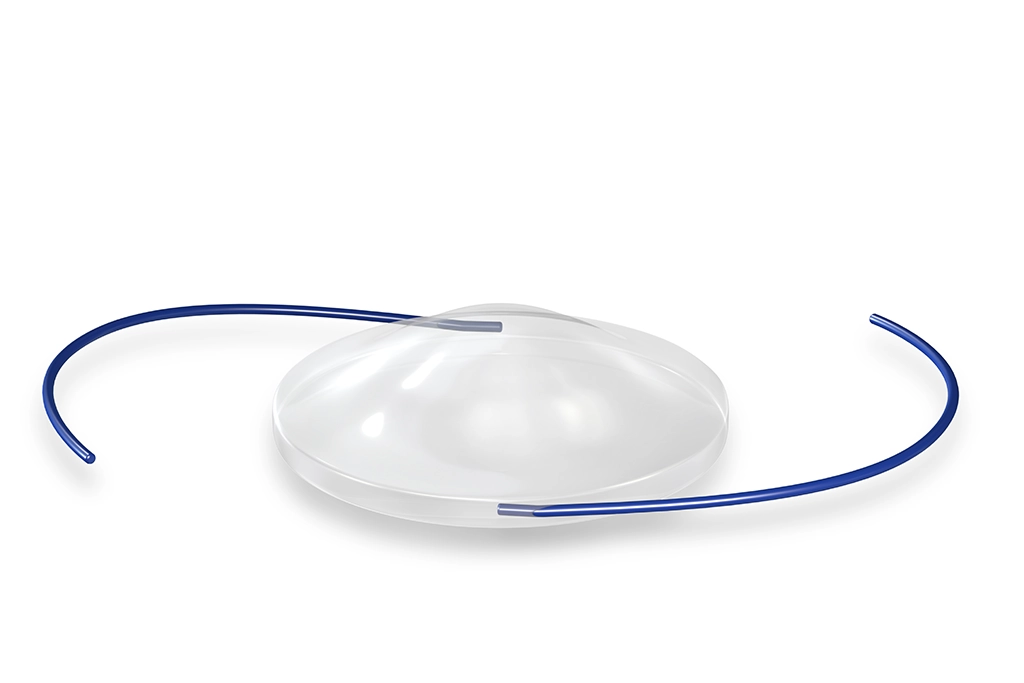
Since the Light Adjustable Lens is a monofocal lens, there is low risk of dysphotopsias caused by splitting light, leading to potentially enhanced vision and patient satisfaction.
The Light Adjustable Lens offers LASIK-like accuracy in cataract surgery.2,3
92% of eyes (N = 391) achieved results within 0.50 D of target manifest refraction spherical equivalent (MRSE).
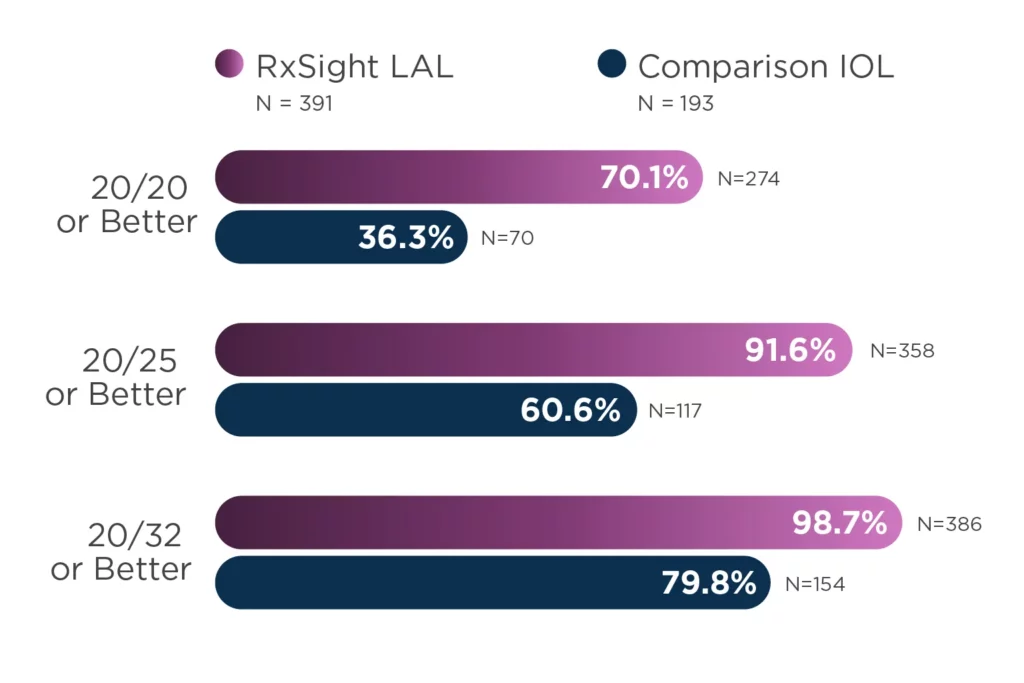
Patients are approximately two times more likely to achieve 20/20 vision or better without glasses at 6 months.
The study was a prospective, controlled, multicenter, 12-month study of 600 patients (ITT population) randomized to receive implantation with the RxSight LAL (N = 403) or a commercially available monofocal IOL (N = 197). Effectiveness analyses included 391 LAL patients and 193 control patients. Primary safety variables included best spectacle-corrected visual acuity (BSCVA) at 6 months and incidence of sight-threatening complications and adverse events. Primary effectiveness variables included percent reduction in manifest cylinder at 6 months, percent mean absolute reduction in MRSE at 6 months, and rotation of meridian of LAL at 6 months. Percent of eyes with an uncorrected visual acuity (UCVA) of 20/20 or better at six months post-operatively compared between the LAL treatment group and the monofocal control group was a secondary endpoint.
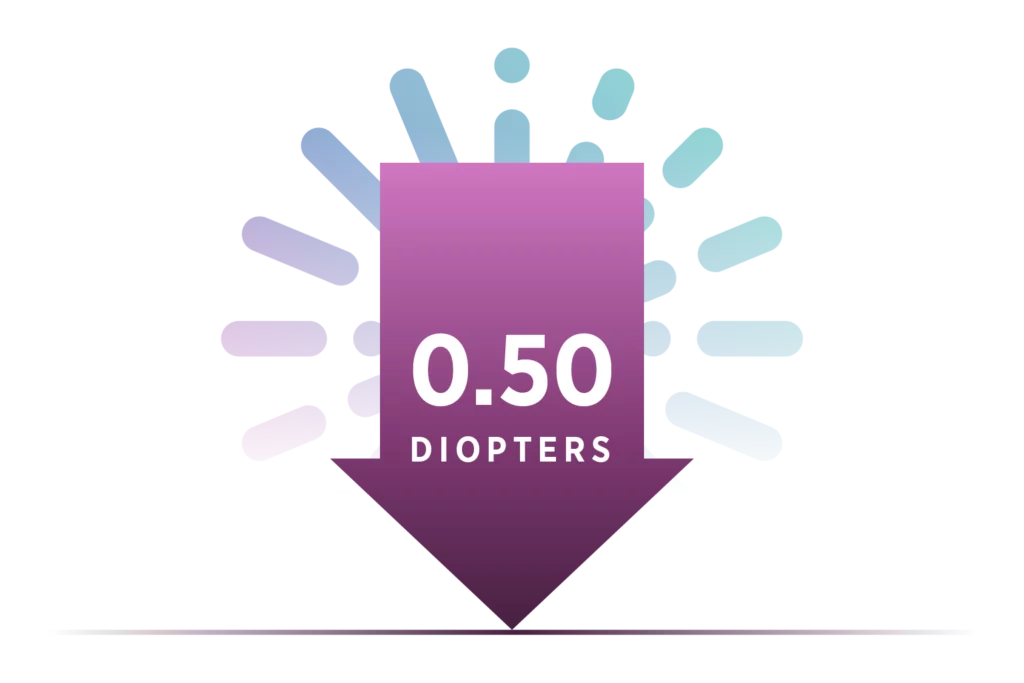
The Light Adjustable Lens corrects as low as 0.50 D of astigmatism, which is the lowest level approved to be treated.
The ability to treat 0.50 D of postoperative cylinder makes the Light Adjustable Lens the only IOL in the United States approved to correct this level of vision-altering astigmatism.
Astigmatism of as little as 0.50 D can reduce visual acuity by one line, and the impact on dynamic, functional visual acuity and low-contrast acuity is even greater.1